Bias and facts suppression in 'The Hindu' reporting: A media analysis
A comparison of the report of police action on Malaysian Hindu rally as reported in The Hindu with the report of the same incident in other International News Agencies.
The event:
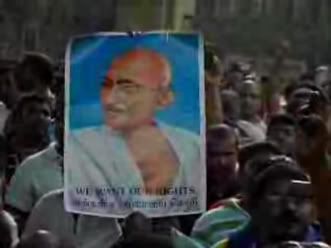
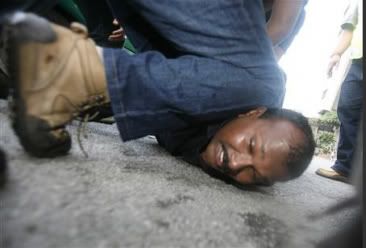
On November 25 2007, despite ban more than 5000 Hindus –mostly Tamils of ethnic Indian origin- gathered in the main street of Kuala Lumpur, the capital city of Malaysia, to take up a rally to submit a petition signed by more than 100,000 members the community, to British High Commission urging the British government to compensate the historical wrong done to them by colonial British by bringing them to Malaysia mostly as indentured labourers which in turn has today reduced them to third class citizens under the Islamist rule in Malaysia. The protestors mostly peaceful were attacked by water cannons and later chemicals. Clutching the photos of Mahatma Gandhi the Hindus offered to court arrest rather than give up their right to protest for justice and equality.
The Newspaper:
'The Hindu' is a leading English-language newspaper in South India, with its largest base of circulation in Tamil Nadu. It has a readership of 2.2 million. Worldpress.org lists the Hindu as a left-leaning independent newspaper. There has been of late criticism of the newspaper that its reports have become more and more biased and are intentionally omitting inconvenient facts thus denying its readers the real news. Here we see if there is any truth in this criticism by studying the report that came in ‘The Hindu’ regarding the aforesaid events and comparing it with the reports of the same event by other major International news agencies which include the BBC, the CNN, the Reuters and 'Telegraph' of Britain.Headings:
BBC reported the event with the heading ‘Malaysian police break up rally’. British newspaper ‘Telegraph’ heading said: ‘Malaysian police halt Indians' protest’. There are two Reuter’s reports. Heading of one report says: ‘Indian protest rocks Malaysia ahead of polls’ and another with video footage says, ‘Police break up protest in Malaysia’. As against such headings which show either the strength of the protest or the police action taken on the protestors, ‘The Hindu’ report states flatly in its heading: ‘Malaysian Indians stage protest rally’.
Regarding demonstration:
- The BBC report of the event says:
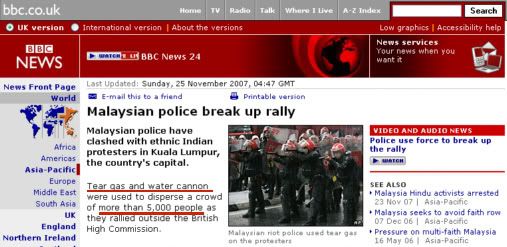
“Malaysian police have clashed with ethnic Indian protesters in Kuala Lumpur, the country's capital. Tear gas and water cannon were used to disperse a crowd of over 5,000 people as they rallied outside the British High Commission.”
- The Telegraph report says:
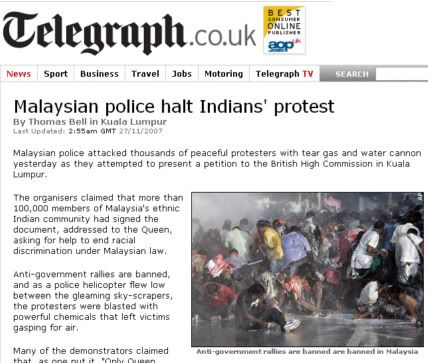
“Malaysian police attacked thousands of peaceful protesters with tear gas and water cannon yesterday as they attempted to present a petition to the British High Commission in Kuala Lumpur.”
- The CNN report says:
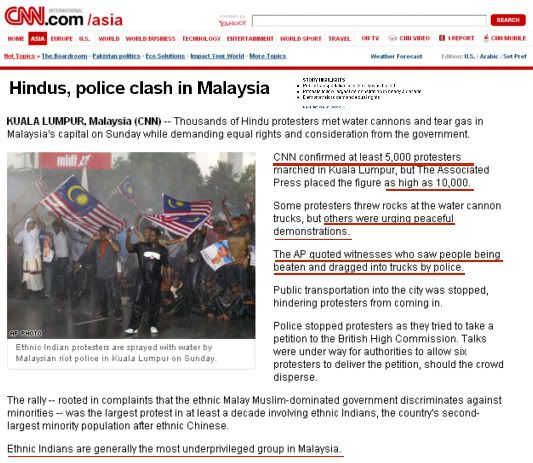
“Thousands of Hindu protesters met water cannons and tear gas in Malaysia's capital on Sunday while demanding equal rights and consideration from the government.”
- The Reuters report says:
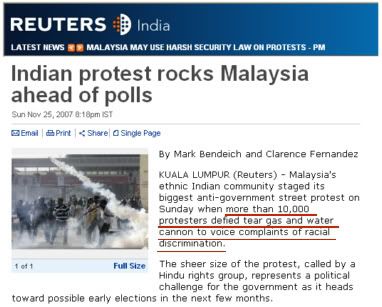
“Malaysia's ethnic Indian community staged its biggest anti-government street protest on Sunday when more than 10,000 protesters defied tear gas and water cannon to voice complaints of racial discrimination."
- Now as against these, this is what ‘The Hindu’ says:
A group, called the Hindu Rights Action Force, on Sunday defied a court order and staged a rally in Kuala Lumpur, protesting against the alleged “marginalisation” of the ethnic Indian minority in Malaysia. Police used water cannon and tear gas to disperse the agitators at one or two places in the city in the morning. The group had mobilised at least a few thousand activists in a rare show of defiance by the members of the community.
It is curious to note how ‘The Hindu’ reporter waters down the violence employed by the Malaysian police which all other reports have brought out succinctly. While both BBC and Reuters put the protest figures at ’over 5000’ and ‘more than 10000’ respectively ‘The Hindu’ saw it fit to write the number of protestors as ‘at least a few thousand’. While every other report spoke of Hindus braving the water cannons and teargases at the streets of Malaysian capital, ‘The Hindu’ saw it fit to mention the police attack on the peaceful demonstrators as having happened ‘at one or two place’.
Nevertheless ‘The Hindu’ report mentions without fail that ‘No exact number of the protesters at Sunday’s rally, some of whom turned violent, was available.’ BBC report never mentions violence by the protestors. Telegraph reported that the protest was peaceful. CNN which mentions the retaliation of some of the protestors to the water cannons also mentions that even they were restrained by the rally organizers not to retaliate. Thus the CNN report says: “Some protesters threw rocks at the water cannon trucks, but others were urging peaceful demonstrations.”
Silence on the violence:
- BBC report quoting Associate Press news agency says,
”Some demonstrators were beaten and bundled into police vans, as tear gas and water cannon were fired into the crowd, according to the Associated Press news agency.”
- Reuters report states:
“Riot police fired at the protesters with sustained volleys of tear gas and jets of water laced with an eye-stinging chemical, but it took more than five hours to finally clear the streets of downtown Kuala Lumpur, by then littered with empty gas canisters.”
[Online video of the Reuters shows protestors sitting cross-legged before the water cannons and even women demonstrators being handcuffed by Malaysian police.] - CNN report says “The AP quoted witnesses who saw people being beaten and dragged into trucks by police.”
- Telegraph says
“…as a police helicopter flew low between the gleaming sky-scrapers, the protesters were blasted with powerful chemicals that left victims gasping for air.”
- And ‘The Hindu’ report says nothing about the violence police unleashed on the peaceful demonstrators.
The alleged ‘inequalities’:
The Hindu report wherever it speaks of the grievances voiced by the ethnic Indian community puts it within double quotes and qualifies it with the term ‘alleged’. Thus ‘The Hindu’ report has the following terms:A group, called the Hindu Rights Action Force, on Sunday defied a court order and staged a rally in Kuala Lumpur, protesting against the alleged “marginalisation” of the ethnic Indian minority in Malaysia…. The rally for “equal rights” was actually planned as part of a move to submit a petition to the British Embassy.(bold font for emphasis - not in the original) ‘The Hindu’ report also carries no statement by any of the community leaders who organized the rally but quotes Malaysian Indian Congress (MIC) leader and Works Minister Samy Vellu who is not in favour of the rally and who wants ‘within the system’. Now against this let us see how other international media have reported the grievances of the Hindus:
- BBC report:
But the BBC's Robin Brant in Kuala Lumpur says the real goal of the demonstrators is to highlight what they see as the unfair treatment of minority Indians in Malaysia. Ethnic Indians - mainly Hindus - form one of Malaysia's largest minority groups. Activists say that many Hindus live in poverty, partly because of policies granting jobs and economic advantages to the ethnic Malay Muslim majority. "Indians are treated like third-class citizens. The community has been suffering in silence for decades," said opposition politician M. Kulasegaran. The government has rejected claims of unfair discrimination.
- Reuters report:
"Malaysian Indians have never gathered in such large numbers in this way...," said organizer P. Uthaya Kumar, of the Hindu Rights Action Force (Hindraf)."They are frustrated and have no job opportunities in the government or the private sector. They are not given business licenses or places in university," he said, adding that Indians were also incensed by some recent demolitions of Hindu temples.
- CNN report:
The rally --rooted in complaints that the ethnic Malay Muslim-dominated government discriminates against minorities -- was the largest protest in at least a decade involving ethnic Indians, the country's second-largest minority population after ethnic Chinese. Ethnic Indians are generally the most underprivileged group in Malaysia.
- Telegraph report:
The government operates an official policy of discrimination in favour of ethnic Malays, or "sons of the soil," who make up just over half of the population. Indians are eight per cent of the population but control just 1.5 per cent of the economy. Another quarter of the population is ethnic Chinese. Access to housing, education, loans and jobs is given to Malays on a preferential basis. The government, which has been led by the same party for 50 years, says the policies are necessary to support the Malay community. The destruction of Hindu temples by the Muslim government has inflamed these economic grievances.
Conclusion:
How the ideological stand of the editorial board affects the reporting pattern of a newspaper can be seen in the above analysis. The report of The Hindu is contrasted with the reports of other International news agencies. The comparison clearly shows how the left-leaning of ‘The Hindu’ newspaper distorts the news and hides facts. Thus the analysis shows how ‘The Hindu’ prefers to stand by its ideological vested interest and deny its readers genuine facts even when the news involves the welfare of the overseas fraternity of the very society that forms the majority of the readership of ‘The Hindu’ In other words:
Appendix – I : Dear Hindu reader, Caveat Emptor!
‘The Hindu’ also carried a news report of the event in the inside page (p.14) It was a highly edited out version of a report of the event filed by Associate Press. The original AP report is given below. The portion of the report which was edited out by ‘The Hindu’ is given in red color.
Malaysian police fire tear gas, water cannons on ethnic Indian demonstrators
Report by JULIA ZAPPEI Associated Press Writer
The Hindu heading:
‘Malaysian Indians allege discrimination
Witnesses saw people being beaten and dragged into trucks by police. Shoes and broken flower pots littered the scene after protesters scattered to hide in hotels and shops. Police said 241 people had been detained, but that nearly half were released after authorities recorded their personal information. Four policemen were injured, federal police said in a statement, but there was no immediate estimate of injuries among protesters.
KUALA LUMPUR, Malaysia (AP) Police used tear gas and water cannons on Sunday to crush a banned rally by more than 10,000 ethnic minority Indians a rare street clash that exposed Muslim-majority Malaysia's deep divisions. Slogan-shouting protesters hurled water bottles and stones at police, who chased them through streets surrounding the famous Petronas Twin Towers and doused them repeatedly with tear gas and chemical-laced water for more than eight hours.
The rally rooted in complaints that the ethnic Malay Muslim-dominated government discriminates against minorities was the largest protest in at least a decade involving ethnic Indians, the country's second-largest minority population after ethnic Chinese. The ethnic Indians are generally the most underprivileged.
``This gathering is unprecedented,'' said protest leader P. Uthayakumar. ``This is a community that can no longer tolerate discrimination.''
It was the second street protest in Kuala Lumpur this month. A Nov. 10 rally that drew thousands of people demanding electoral reforms was also broken up with similar force, but lasted only a few hours.
Street demonstrations are extremely rare among the multiple ethnic groups in Malaysia, which prides itself on its communal and political stability. The two protests indicate that Malaysians are becoming bolder about venting their frustrations publicly against a political system that concentrates power and influence in the hands of the Malay ruling elite. Samy Vellu, the government's top ethnic Indian politician, denounced Sunday's protest as ``an opposition ploy to smear the government's image.'' Malaysia has maintained racial peace since 1969, when some 200 people were killed in riots sparked by Malay frustration over the economic clout of Chinese. The violence spurred the creation of programs that give Malays privileges in government jobs, contracts and education.
The latest rally was meant to support a US$4 trillion (euro2.7 trillion) lawsuit filed in London in August by the Hindu Rights Action Force, a Malaysian rights group, demanding that Britain compensate Malaysian Indians for bringing their ancestors to the country as ``indentured laborers'' and exploiting them. Ethnic Indians say discrimination continued after Malaysia's independence in 1957 because of an affirmative action policy favoring Malays, who comprise about 60 percent of the country's 27 million people.
Associated Press reporter Sean Yoong contributed to this report. (Copyright 2007 The Associated Press. All Rights Reserved.)
References and notes:
- Write-up on The Hindu based on Wikipedia entry of The Hindu available at the URL: http://en.wikipedia.org/wiki/The_Hindu
- The Hindu report on the Malaysia rally and police action is available at the URL: http://www.hindu.com/2007/11/26/stories/2007112656300100.htm
- The Reuters report on the event:
http://www.reuters.com/article/newsMaps/idUSKLR16504820071125 - The BBC report on the event:
http://news.bbc.co.uk/1/hi/world/asia-pacific/7111646.stm - The CNN report on the event:
http://edition.cnn.com/2007/WORLD/asiapcf/11/25/malaysia.protests/ - Telegraph report on the event:
http://www.telegraph.co.uk/news/main.jhtml?xml=/news/2007/11/26/wmalaysia126.xml - [All URL as accessed on 26-Nov-2007 Indian time: 3:00 pm]
Labels: anti-HIndu hatred, anti-hinduism, Hate crimes against Hindus in TN, Hindu Human rights, Malaysian Hindu Human rights, Media bias, Misreporting, N.Ram, racism, The Hindu, unethical journalism
posted by அரவிந்தன் நீலகண்டன் | 10:30 AM
|
13 comments